Reading Peig Sayers
And others: some books, some links


I have a soft spot for “required reading”—for books that everyone has to read and that everyone seems to hate.
I like literary traditions.
I think that it is salutary, in fragmented societies, to have a core of works that people know and share.
I know that kids often resent such works. If I had a nickel for every Brazilian who told me they didn’t like Clarice Lispector because they had to read her in high school! Maybe it was the wrong time for them; maybe the teacher didn’t teach her right. And maybe, for every student who didn’t like her, there was another whose life was changed by her.
I mention this because last year, when I was in Ireland, my friend Amanda told me that her kids were studying an oral storyteller named Peig Sayers in their Irish language classes. The kids hated Peig, she said. They made fun of her stories about rotten potatoes and dead mules.
I instinctively rallied to Peig’s defense. I looked her up: she lived on Great Blasket Island off the west coast of Ireland; she died in 1958. In photos, she seemed appropriately ancient, appropriately bardic, and I was intrigued enough to buy An Old Woman’s Reflections: The Life of a Blasket Island Storyteller in the Irish-language bookshop in Dublin, An Siopa Leabhar.
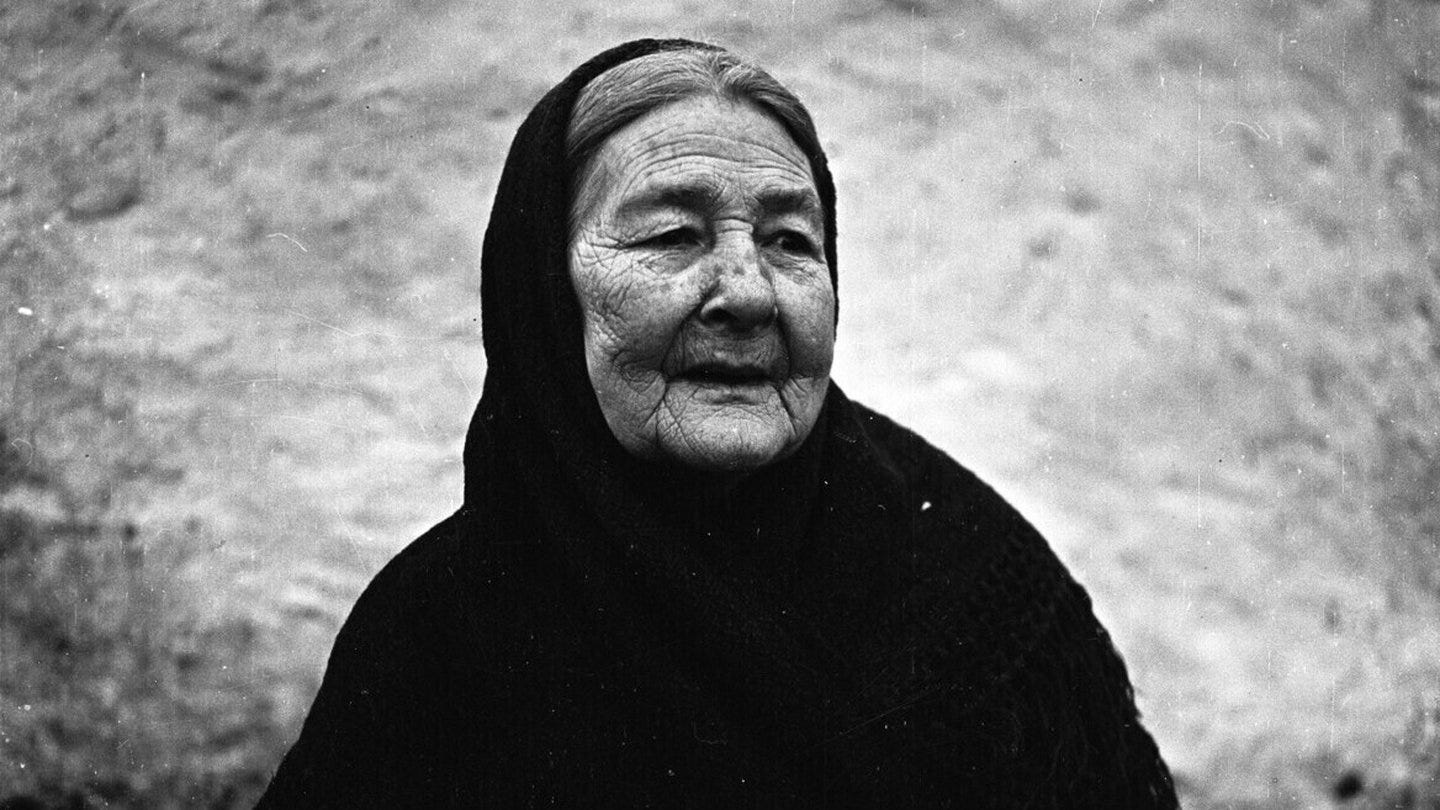
I looked at the book at the time—but then I got back home, got busy, didn’t read much more. Christmas is the time when I always get to dig back through the piles of books and pluck out something I had meant to read (see below). This year, I plucked out Peig.
The kids were right. Peig was surely better on Great Blasket Island, its long winter nights undisturbed by electricity, than she is today. The stories wander and ramble. She seems to have had a magnetic personality. She seems to have had a poetic mastery of the Irish language, which I can’t judge. But the stories, as stories: I didn’t really get them.
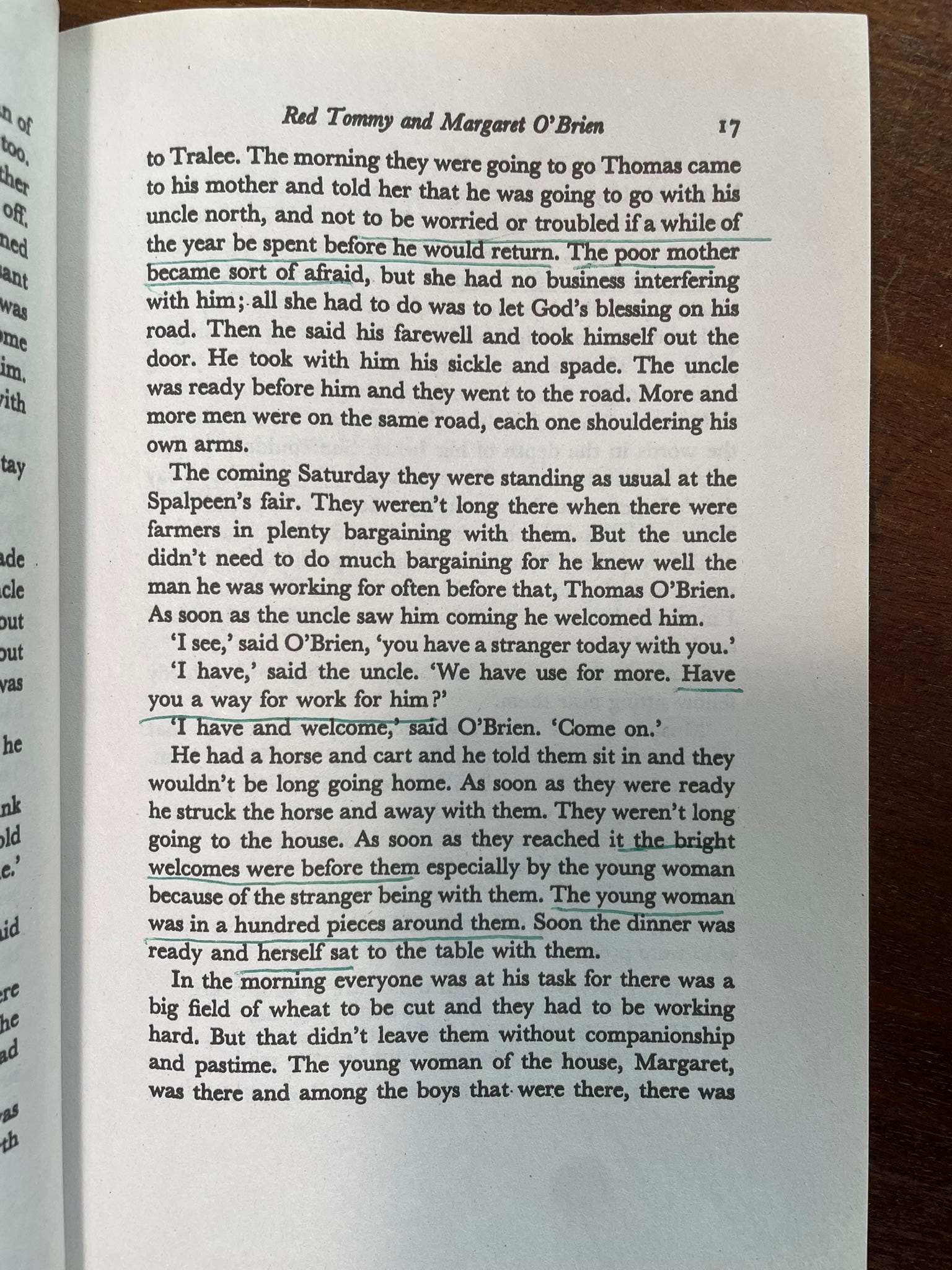
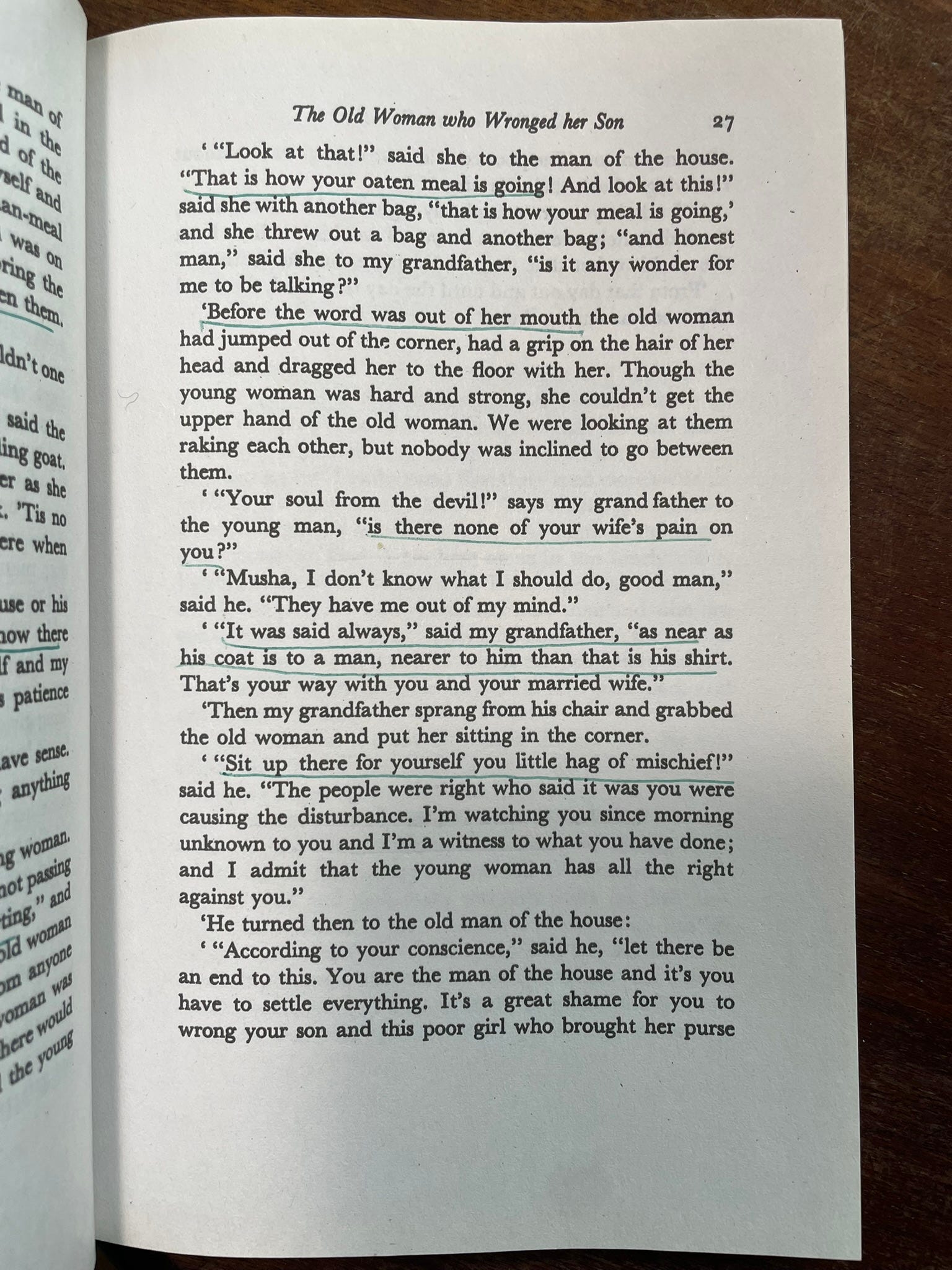
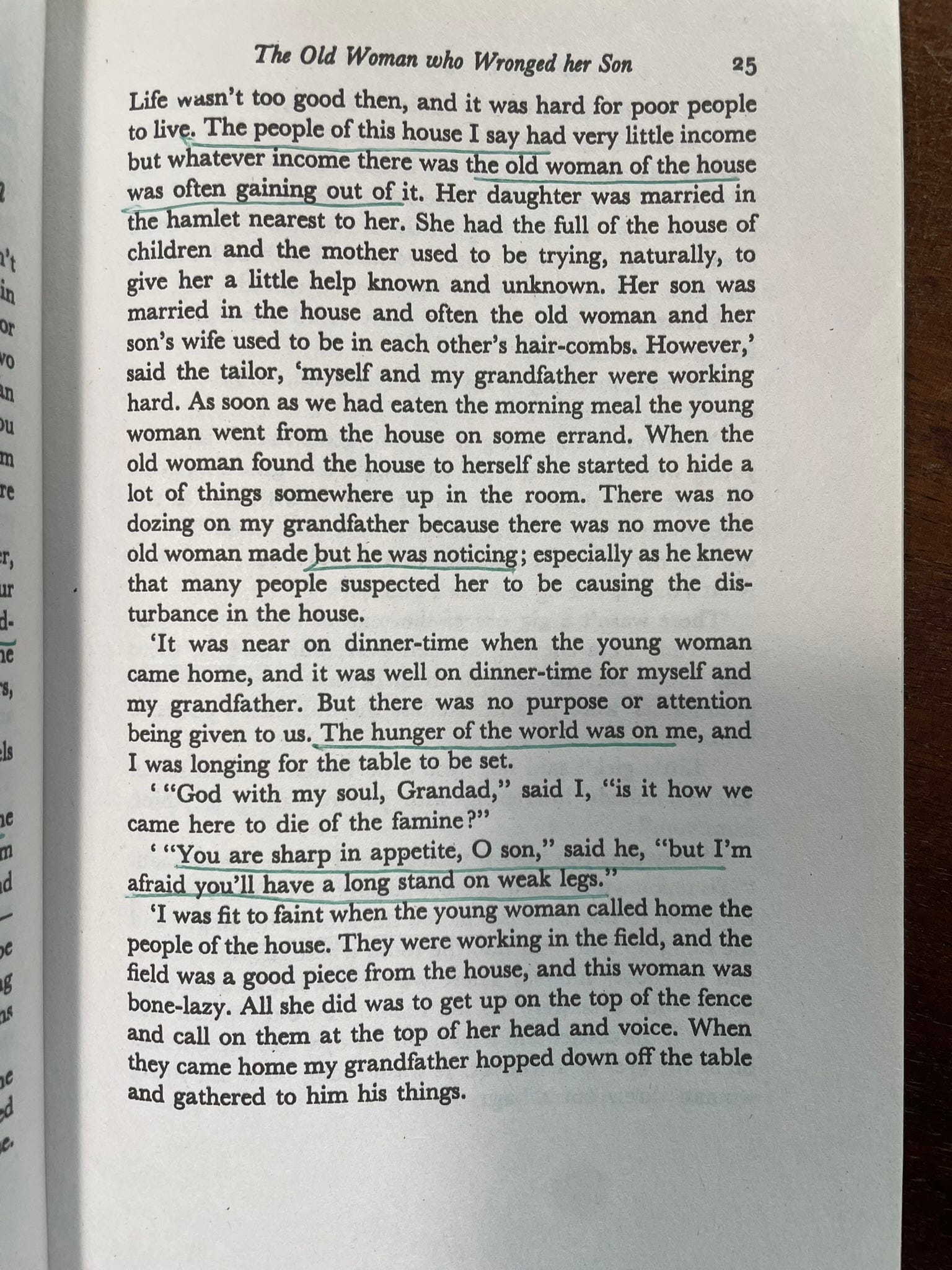
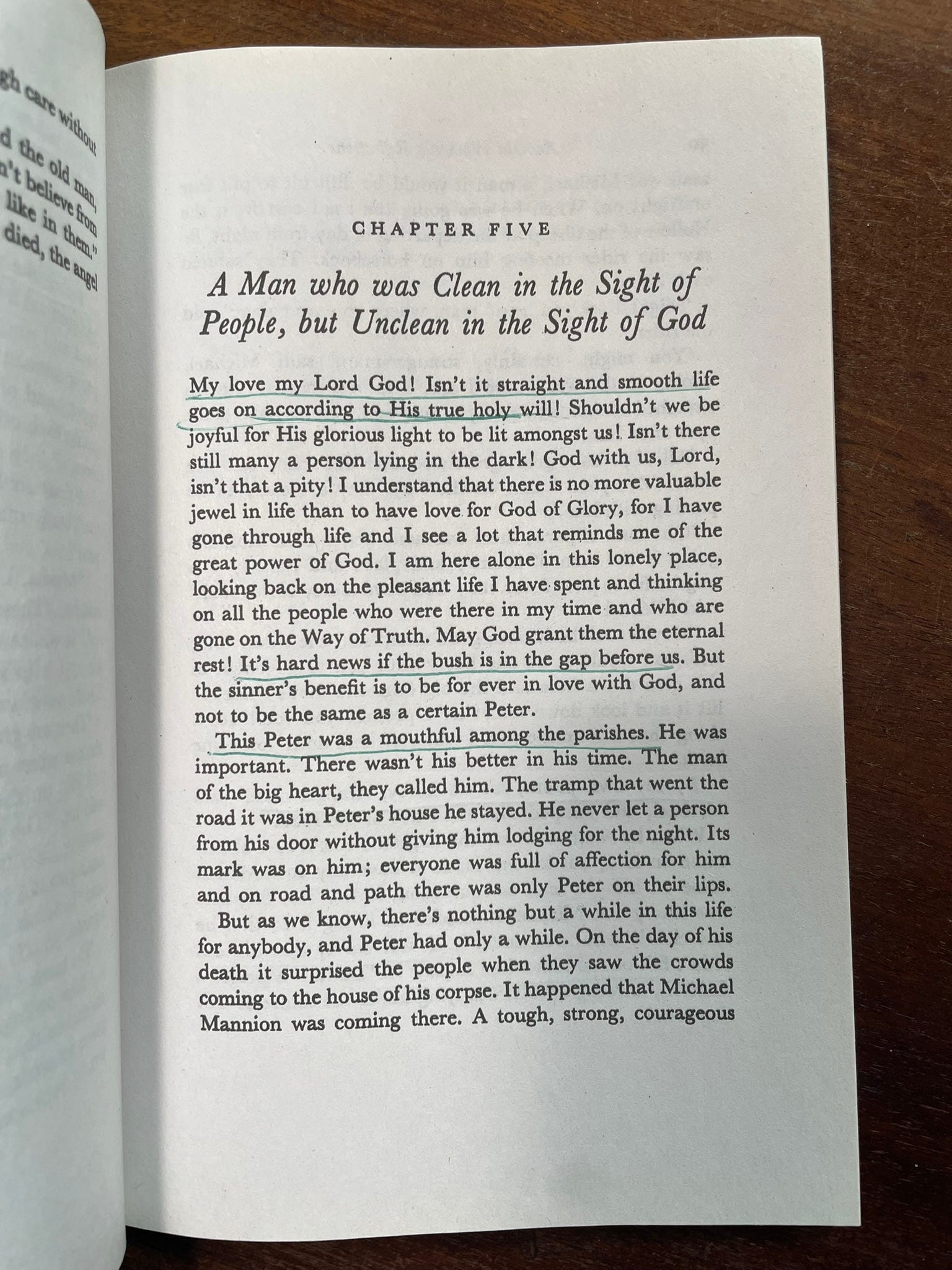
The real surprise, though, was the translation. By Séamus Ennis, a musician and collector of Irish folk-songs, it took me into a foreign poetry that I could never have entered otherwise. Though I’ve visited here and there over the years, I haven’t spent much time in Ireland—nor, alas, have I spent much time reading the Irish writers. This Irish English was so fascinating and rhythmic and beautiful that I could, or at least I thought I could, hear Peig’s original Irish language behind it. I’ll post a few pages with some of the expressions I underlined.
Aren’t they wonderful!
I was in a thousand pieces around it!
Peig and Séamus were a mouthful among my parishes!
Christmas seems to be the only time of the year when I actually get to read. Not the stuff I have to read professionally — for research, for writing, for blurbs — but just for the hell of it, and especially books written by friends.
When you’re a writer, there are always so, so many of these, and they gather—looming—glaring—a Mountain of Guilt—a Peak of Reproach.
But I don’t read them because I feel guilty. I read them because I (usually) enjoy them. The only reason I don’t read them is because I’m such a slow reader, and I never have enough time.
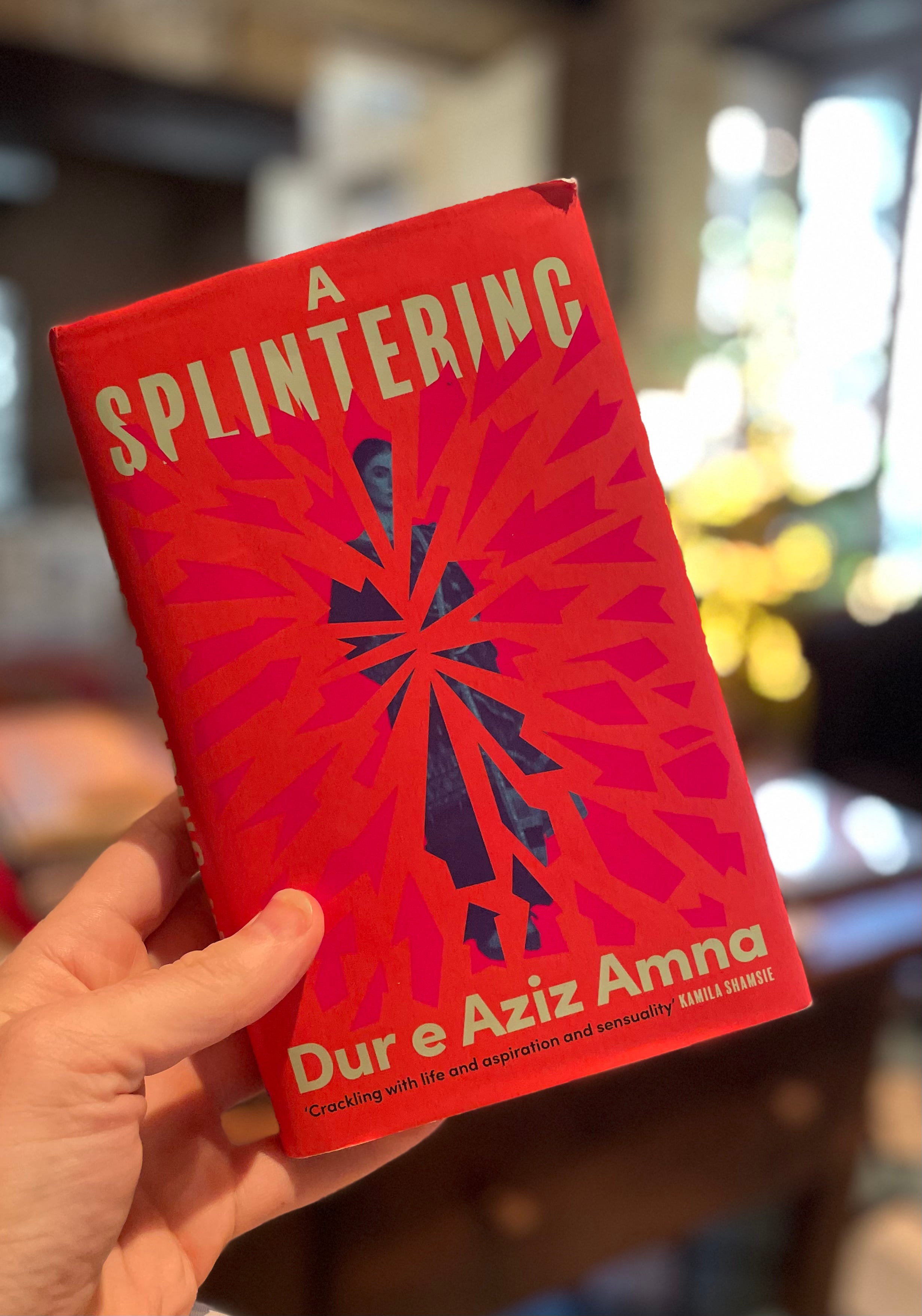
Besides Peig, I have read a couple of wonderful novels this last week, both by friends. Dur e Aziz Amna is a new friend, someone I met digitally when she sent me her first book a few years ago. I loved that book, and, in the way that sometimes happens, I knew from the book that we would be friends. We recently met in person. At that long-delayed meeting, she gave me this new book and—you should read it! I don’t know how to say why without sounding too blurby, but it is the story of a smart and ambitious girl from a crummy town in Pakistan who comes to the capital and, in her own bloody way, triumphs. It spans decades in less than three hundred pages—a big achievement for any writer, especially when a book has as many complexities and twists and characters as this one does. It’s been a long time since I whizzed through a book with as much pleasure as I did this one.
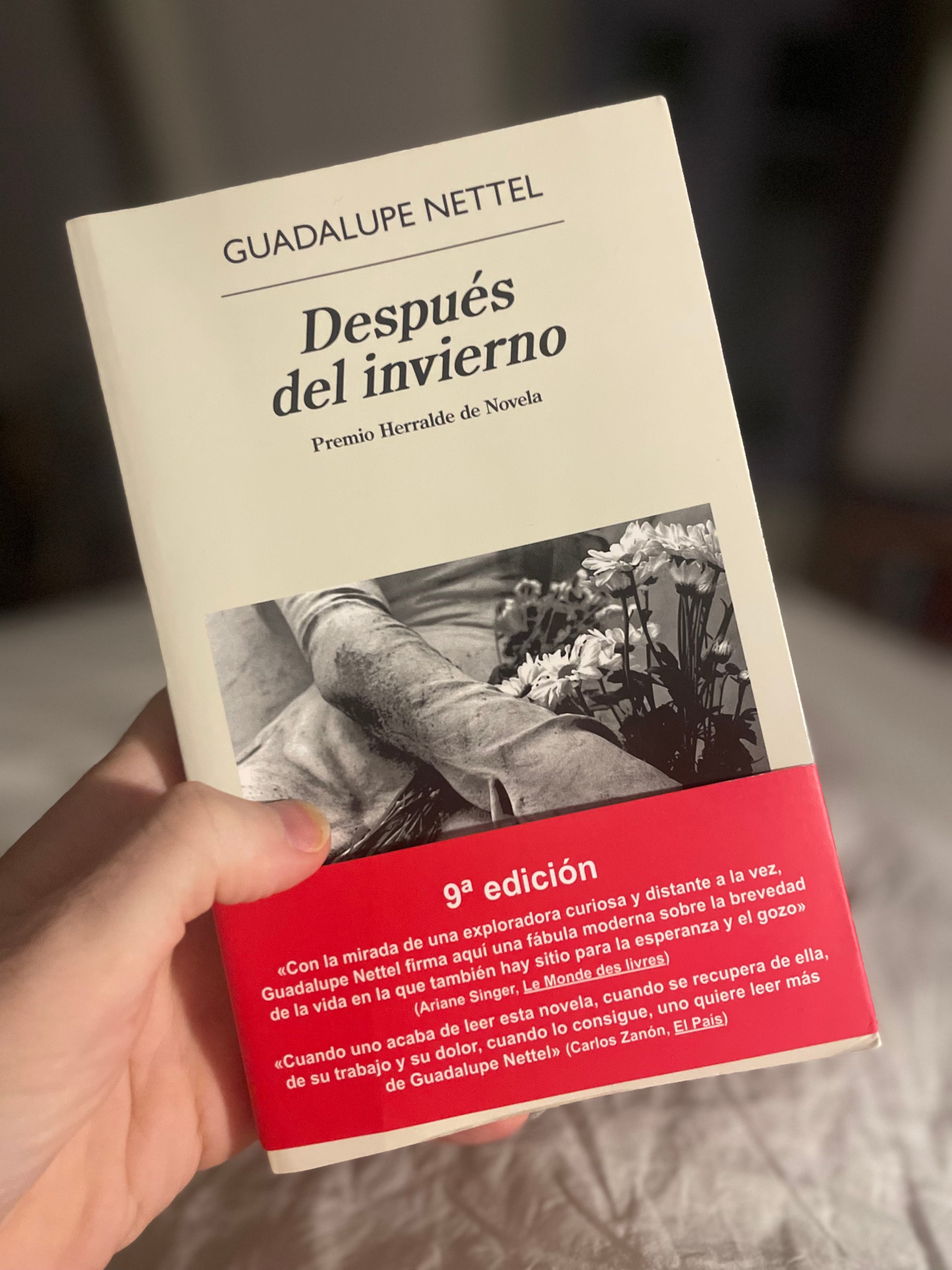
I then got to read a book by another new friend, the Mexican novelist Guadalupe Nettel. For those of you who read Spanish, I can’t recommend this highly enough. This book belongs to a genre or sub-genre which I’ve always loved, novels about people who go to study or work abroad and end up lingering, maybe forever, in the semi-purgatory, semi-heaven of “abroad.” This book is a love story, but it’s not the love story that you think is going to unfold. It twists and turns as we start to discover what actually is unfolding.
Finally, since it’s the holidays and you are probably spending even more time on your phone than usual, I’m sending some links to some other things I recommend, just in case you feel like clicking around.
On Zionism/Israel/Palestine:
An essay by the excellent Nate Bear about the massacre at Bondi Beach, and about why certain massacres, when committed against certain groups of people, seem (!) to get more coverage than when certain other groups of people are massacred.
Also by Nate Bear: a few interesting thoughts about the phrase “globalize the intifada,” which is supposedly causing more damage to Jews than … well, than other things that one might think of that are causing damage to Jews.
By Rabbi Shaul Magid, an essay about how the impossible contradictions of so-called “liberal Zionism,” part of a bigger series in which Rabbi Magid describes the impossibilities of sustaining a belief in universalism with a belief in racial nationalism, a.k.a. Zionism.
By Natalia Ginzburg, with a formidable preface by Pankaj Mishra, a couple of essays about Zionism that date to long before the present crisis.
By David Velasco, who was fired from Artforum for protesting the genocide, an essay on a subject that, for so many different reasons, is close to my heart: “How Gaza Broke the Art World.”
On V.S. Naipaul:
By my friend Aatish Taseer, a reminiscence of my hero/scourge V.S. Naipaul, visiting a museum in Delhi.
And speaking of Naipaul, here I am speaking of Naipaul in a podcast with William Dalrymple and Anita Anand.
On Willie Nelson:
A beautiful piece about another hero of mine, Willie Nelson, by Alex Abramovich, that includes this fabulous paragraph:
How can you make sense of him? How would you define the indefinable or the unfathomable? What is there to say? Ancient Viking Soul? Master Builder of the Impossible? Patron poet of people who never quite fit in and don’t much care to? Moonshine Philosopher? Tumbleweed singer with a PhD? Red Bandana troubadour, braids like twin ropes lassoing eternity? What do you say about a guy who plays an old, battered guitar that he treats like it’s the last loyal dog in the universe? Cowboy apparition, writes songs with holes that you can crawl through to escape from something. Voice like a warm porchlight left on for wanderers who kissed goodbye too soon or stayed too long. I guess you can say all that. But it really doesn’t tell you a lot or explain anything about Willie. Personally speaking I’ve always known him to be kind, generous, tolerant and understanding of human feebleness, a benefactor, a father and a friend. He’s like the invisible air. He’s high and low. He’s in harmony with nature. And that’s what makes him Willie.
On Norman Podhoretz:
Podhoretz died this week. What a loss! you might snort—and you would be right to snort, since Podhoretz was a particularly nasty, but also particularly fascinating, piece of work.
Here’s David Klion in The Nation with a great obituary.
Here, I think, is an older piece I wrote about my own interactions with Podhoretz. If this link doesn’t work, I will send you a PDF.
On John Olson:
John Olson died on December 9. I can’t remember when I didn’t know John: his family were such old friends of mine. He was best known for his role in bringing down Enron. At a time when business and corporations and politics seem so hopelessly corrupted—when the Enrons of the world seem to have won—John’s courage showed that there will always be a role—a thirst—for people of integrity and decency. He was remembered with wonderful obituaries in The New York Times and in The Wall Street Journal.
I was trying to give words to the life of Willie Nelson last week. Thank you for sharing the passage by Alex Abramovich: it was exactly what I couldn’t articulate. So beautiful. Happy Holidays Benjamin!
Most of these books are discoveries for me, and look to be wonderful ones. These are gifts. Thank you. The Natalia Ginsburg is in my guilt-generating pile. My favorite read this year was Jeet Thayil's The Elsewhereans. Check it out. Happy Holidays.